Tuesday, 10 August 2021

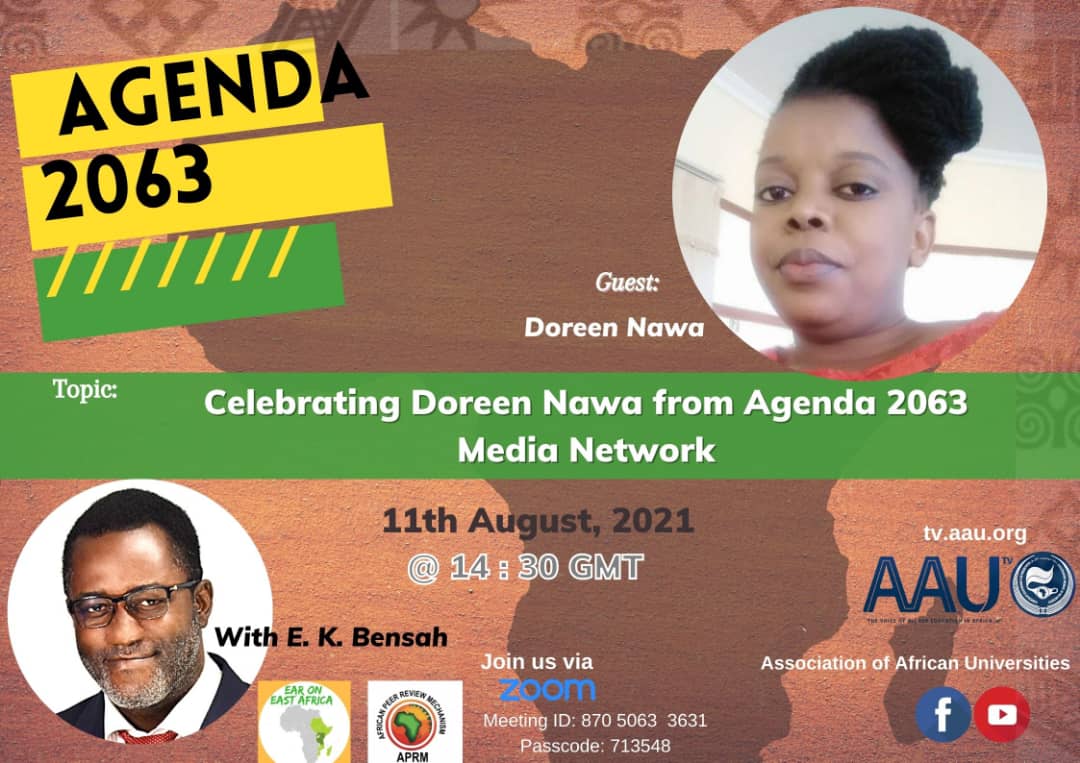
Next Edition of Agenda 2063 TV Show: Celebrating Doreen Nawa (Zambia)


In next edition of *Agenda 2063 TV Show*, I will be interviewing *Doreen Nawa*, who was nominated by her peers in the official NEPAD-AUDA *Agenda 2063 Media Network* as one of the most hard-working journalists promoting Agenda 2063 from Zambia.


I am doing two things with this interview -- helping celebrate hard-working reporters promoting Agenda 2063, and giving visibility to the Agenda 2063 Media Network, which was established in 2018 by NEPAD-AU Development Agency to bring together journalists across the Continent to champion Agenda 2063. 


Ghana's country Champion is the host of the Show and is also a proud member of the Network. 


This is *dedicated to all reporters* doing their best to unpack Agenda 2063 narratives: the space is here!😁🔥


AAU TV is inviting you to a scheduled Zoom meeting.


Topic: Agenda 2063 TV Show

Time: Aug 11, 2021 02:30 PM Africa/Accra


Join Zoom Meeting

https://us02web.zoom.us/j/87050633631?pwd=TGRsbEwycWJjdWNESk1hYTZQZFJjZz09


Meeting ID: 870 5063 3631

Passcode: 713548

One tap mobile

+13462487799,,87050633631# US (Houston)

+16465588656,,87050633631# US (New York)

Sunday, 8 August 2021

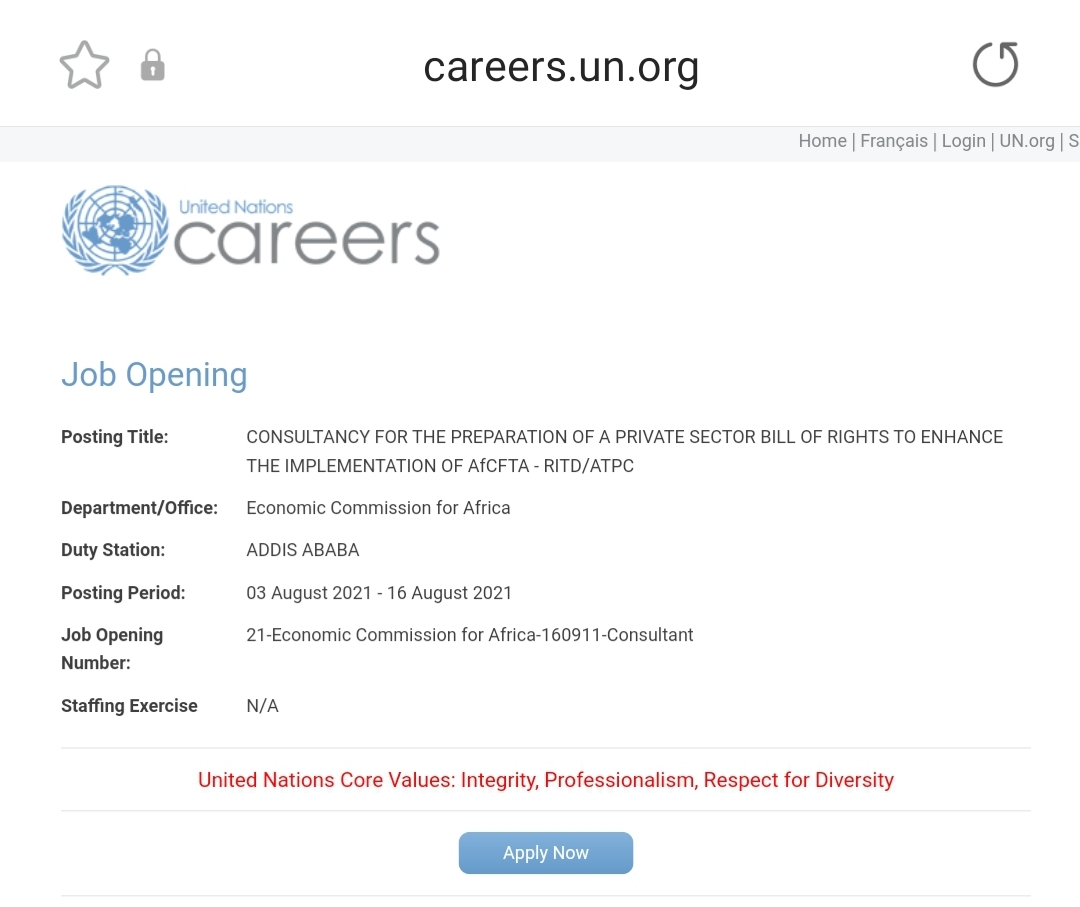
FOR IMMEDIATE RELEASE: TENDER FOR PREPARATION OF A PRIVATE SECTOR BILL OF RIGHTS TO ENHANCE IMPLEMENTATION OF AFCFTA


Accra, 7 August, 2021


FOR IMMEDIATE RELEASE: 

TENDER FOR PREPARATION OF A PRIVATE SECTOR BILL OF RIGHTS TO ENHANCE IMPLEMENTATION OF AFCFTA


We are pleased to announce a consultancy for the preparation of a Private Sector Bill of Rights to Enhance Implementation of African Continental Free Trade Area (AfCFTA).


This tender is one of the three outcomes of an MoU that was signed between Association of African Universities (AAU) and Pan-African Chamber of Commerce (PACCI) in March 2021. 


The second is for the establishment of an Educational Trust Fund; and a corresponding working relationship between private sector and academia.


The AAU in collaboration with PACCI, the United Nations Economic Commission for Africa (UNECA), the European Union (EU) and the private sector, organized an African Private Sector Summit on, "Righting the Wrongs of Doing Business in Africa" in March 2021. This summit brought together stakeholders from industry, governments, academia, and civil society. 

Attended virtually by three Presidents: Botswana, Rwanda (represented by a Minister) and Niger (represented by a Minister), one of the outcomes of the week-long event was a call for a Model Bill of Rights for an Enabling Business Environment in Africa to Enhance Implementation of AfCFTA. This is premised on the notion that an enabling operational environment for the private sector in Africa would help support the implementation of AfCFTA. The final Bill will be validated by stakeholders, including member States, universities, and civil society organisations (CSOs) for validation. 

The key objective of the Bill of Rights is intended to address pertinent issues for the seamless implementation of the RECs and AfCFTA protocols.  It is to help Universities produce a skill-set for private sector.

In this respect, it forms a cardinal part of the conversation triggered by the meeting for a concerted and sustained conversation between African private sector, academia, consumer organisations and citizens.

Funded under an EU/ECA project on advocacy and sensitization of AfCFTA, the following should, at a minimum, be explored and covered in proposing the Model Bill of Rights:

  1. National trade policies

  2. National monetary and fiscal policies

  3. National investment policy 

  4. The enabling environment for doing business in Africa in the context of judicial system.

  5. Capacity constraints of businesses in Africa 

  6. Role of multilateral and other international organizations in promoting business in Africa (WTO, UN/UNECA, AU, RECs, ITC, IMF, WB, Lending Institutions, etc.)


You can find more details in the link below:

https://careers.un.org/lbw/jobdetail.aspx?id=160911


In the meantime, we wish to notify the public that Series II commences in hybrid format here in Accra from 19-22 October, 2021. Series III will take place in Rwanda from 16-19 November under the theme "Action Plan for Implementation". 


FOR MORE INFORMATION & INTERVIEWS


E.K.Bensah Jr

Head of Communications Unit

Africa Private Sector Summit

Mobile: +233.268.687.653 / +233.55.833.85.47

Twitter: @ekbensah / @BizWrongs

Instagram: @ekbensah

www.facebook.com/africaprivatesectorsummit


Issued by:

E K Bensah Jr

+233.833.85.47


Saturday, 7 August 2021

*MAIDEN REPORT OF #WAMKELESPEAKS*


*MAIDEN REPORT OF #WAMKELESPEAKS*

by _E.K.Bensah Jr_

*August 2021*


*Introduction*

On 24 June, 2021, Secretary-General of Afcfta made a 26-minute presentation at a "Summit", which was organised by regional integration think-tank, AfCFTA Policy Network, to assess the "State of AfCFTA Trading Six Months On". 


As part of continuous monitoring of Agenda 2063 and its seven aspirations, Deputy Executive Director of APN, E K Bensah Jr, undertook to examine his speech and identify the extent to which his speech reflected 7 aspirations of Agenda 2063. To this end, Bensah put his speech through an "APN-ometer".


*Methodology*

The 26-minute video was divided into five videos of around 4.5 minutes each to make it easier to pay greater attention to the rhythm of the speech and how closely Mene was sticking to Agenda 2063 aspirations. The 7 aspirations were tabulated against the videos and we measured which aspiration Mene was referring to in each video.


*Results*

In video 1, Mene refers to "market integration" and "seamless movement of goods and persons". This a reference to aspiration 2 that speaks to an "integrated continent". 


Video 2 also refers to market integration (aspiration 2), but touches on aspiration 1 when Mene argues that Africa has never had.this.opportunity before as a continent. This opportunity is consistent with aspiration 1, which calls for a prosperous continent. 


Video 3 also calls our attention to aspiration 1, which is a prosperous continent when Mene draws our attention to Africa's industrial capacity to be celebrated. It also refers to aspirations 6 and 7, when he announces that there will be a protocol in women and for a dynamic young population that will be "a huge market." Mene also announces there will be an Afcfta Business Forum for private sector and CSOs.


In Video 4, Mene refers to Pan-African Payment Settlement Systems platform, and how that will resolve the cost of currency convertibility. He also speaks to availability of an Adjustment Fund. These are consistent with aspirations 1 and 2. Aspirations 6 and 7 are revisited when Mene talks about the African Trade Gateway, where SMEs across the Continent can speak to each other; and how tariff will be an industrial tool. 


Finally, in video 5, Mene harks to aspiration 2 (an integrated continent), when he admonishes Africans on needing to implement daily challenges and difficulties, failing which we will not succeed. He concludes AfCFTA will benefit women in trade and SMEs, which speaks directly to aspiration 6, which calls for an inclusive and people-centred Africa where women and youth are included.


In the videos, there was no reference to aspirations 3 (good governance); 4 (peaceful and secure Africa); 5 (Africa with a strong, cultural identity). 


For us, Mene does very well speaking most of the time to aspirations 1, 6 and 7, but his speech needs to be more reflective of all 7 aspirations. Because of this, we will give him 4/7, just under 50%.


___________


*About #WamkeleSpeaks*

As part of innovating education on Agenda 2063, the office of Deputy Executive Director of APN in collaboration with AAUTV is introducing *#WamkeleSpeaks*


#WamkeleSpeaks is the start of an all-important project seeking to identify the extent to which speeches by the Secretary-General of AfCFTA  go to *streamlining 7 aspirations of Agenda 2063*


#WamkeleSpeaks will help continue the spirit of challenging people on education of 7 aspirations by getting them to think *how truly AfCFTA Secretariat is incorporating all 7 aspirations of Agenda 2063* and walking the talk of the AfCFTA being a flagship project of Agenda2063


*About Agenda2063 TV Show*

_As part of AfCFTA Policy Network's pioneering work on sensitization of AfCFTA, Deputy Executive Director E K Bensah Jr started hosting the Show in January 2020. He was headhunted by Association of African Universities (AAU) to host the uniquely-named Agenda 2063 Show on AAUTV.  It remains the only Show of its kind in Ghana, West Africa, and the Continent telling authentic stories about Africa's integration on a weekly basis, with a specific focus on reminding audiences about the centrality of Agenda 2063. You can view all videos on-demand at http://TV.aau.org/category/agenda-2063_

Thursday, 18 February 2021

Ensuring THE NEW FREE TRADE AREA HAS RULES OF ORIGIN THAT HELP GROW INTRA-AFRICA TRADE

Ensuring THE NEW FREE TRADE AREA HAS RULES OF ORIGIN THAT HELP GROW 

INTRA-AFRICA TRADE


Accra, Wednesday 17 February 2021 ---

How will African countries ensure that the rules that determine the nationality of goods and services traded under the new free trade agreement are transparent, business friendly and simple? 


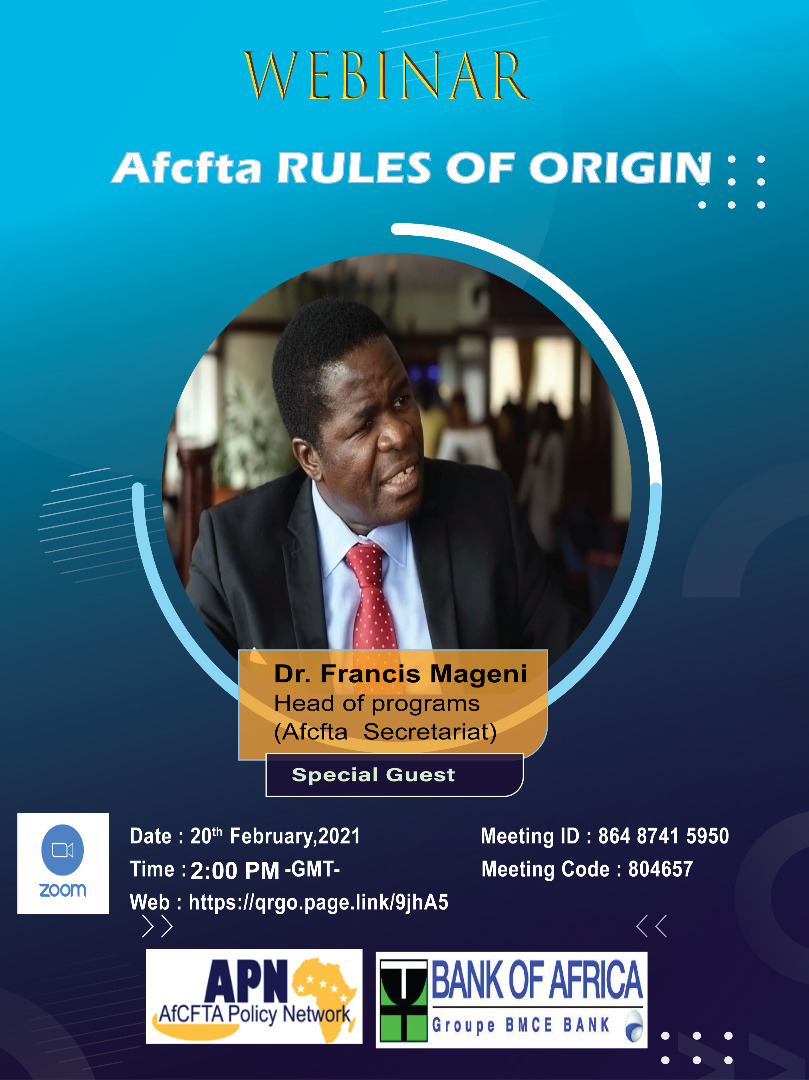
The AfCFTA Policy Network (APN) is hosting a Zoom webinar with a high-powered panel of Ghanaian and international guests who will address this issue. The panelists include the Assistant Commissioner (Tariff and Trade) Customs Division of Ghana Revenue Authority, Fechin Akoto, the Morocco Ambassador to Ghana, H.E. Imane Ouaadil, the  Head of Programs AfCFTA Secretariat, Dr. Francis Mageni, Trade Rules of Origin Expert, Unami Tlhole, the Director of Manufacturing (Quality and Engineering ) General Motors, Shady El Safty, the Managing Director Bank of Africa (Ghana) Mr. Kobby Andah, the Commissioner of Customs Excise and Preventive Service, Ghana Revenue Authority, Col. Kwadwo Damoah Rtd. The event will be held on Saturday 20 February at 2pm.


The forum is organized by the AfCFTA Policy Network in partnership with the Bank of Africa, Group BMCE Bank.0


The Executive Director, AfCFTA Policy Network, Mr. Louis Yaw Afful, said: "The rules of origin are vital to the successful operation of the new African free trade area. In this webinar we hope to hear from experts in public and private sectors about the road map for achieving a set of rules that will stimulate exponential growth in intra-African trade from the current rate of 15 per cent to the predicted rate of 30 per cent."


What is the AfCFTA?


The African Continental Free Trade Area (AfCFTA) agreement has created the largest free trade area in the world measured by the number of countries participating. The pact connects 1.3 billion people across 55 countries with a combined gross domestic product (GDP) valued at US$3.4 trillion. It has the potential to lift 30 million people out of extreme poverty but achieving its full potential will depend on putting in place significant policy reforms and trade facilitation measures. The free trade pact commenced on 1st January 2021


About AfCFTA Policy Network (APN)


The AfCFTA Policy Network was established in 2019 as the lead and largest international non-governmental organization (NGO) focused primarily as a think tank on African Continental Free Trade Area implementation.


Our Vision 


To be the premier information, communication service and governance network representative of the African Continental Free Trade Area Agreement within Ghana and the Diaspora, leading the secretariat and wider, policy network with a globally relevant, continental perspective.


Our Mission


To create, develop, and deliver relevant and superior resource, information streams and systems that attract, engage and impact the biggest audience and positively impact the continental network of traders, regulatory authorities, policy makers and lifestyles to assure maximum value.


End


Zoom Meeting Details


Meeting ID: 864 8741 5950

Meeting Code: 804657


--
*****************************************************
E.K.Bensah Jr, 
*Deputy Executive Director -- AfCFTA Policy Network-Ghana & Diaspora
*AU Department of Trade & Industry Media Network on Africa's Industrialization
*Agenda2063 Media Network Member
*APRM Communicators Network
*M-D, EcowasBusinessNews.blogspot.com
*Head of Comms & Research & Host -- "Africa in Focus Show" /AIFTV
*former Exec Producer -- XYZ Africa News Bulletin@8

#####
http://www.twitter.com/ekbensah | 
*TEL:+233.268.687.653 / +233.233.311.789 / +233.243.111.789
*eml: ekbensah@gmail.com | africainfocusshow@gmail.com
*Telegram/Whatsapp:+233.233.311.789
AFRICA IN FOCUS: africainfocusshow.blogspot.com
________________________________________________________________________________
EKBENSAH DotNet: Regional integration Intelligence| West Africa-ECOWAS | Communications | Civil society 
_________________________________________________________


Monday, 8 February 2021

WEEK-LONG AFRICAN PRIVATE SECTOR SUMMIT: “RIGHTING BUSINESS WRONGS HEADS” TO TRANSFORM THE AFCFTA NARRATIVE FROM 8-12 MARCH 2021


FOR IMMEDIATE RELEASE


WEEK-LONG AFRICAN PRIVATE SECTOR SUMMIT:

“RIGHTING BUSINESS WRONGS HEADS” TO TRANSFORM THE AFCFTA NARRATIVE FROM 8-12 MARCH 2021


Arguably the biggest and most innovative Pan-African initiative to hit all Afcfta-watchers sideways is "Righting Business Wrongs" (#RightingBizWrongs) that seeks to help remind Africans to press policy-makers of an enabling environment, where African business can thrive and prosper; and where Afcfta can work equitably for #TheAfricaWeWant.


The Summit is organised by an impressive galaxy of Pan-African superstar organisations, including


  • Federation of West Africa Chambers of Commerce & Industry

Www.fewacci.com


  • Great Lakes Region Private Sector Forum

www.twitter.com/ICGLR_PSF


  • Pan-African Chamber of Commerce & Industry

www.pacci.org


  • East African Chamber of Commerce, Industry & Agriculture

www.eastafricanchamber.org


  • Association of African Universities

www.aau.org


  • Global Institute of Planning & Sustainable Development

https://www.globalinstitutepsd.org


  • Coalition for Dialogue on Africa (CoDA)

www.twitter.com/CoDA_Africa


  • Wealth Masters Group

https://wealthmastersgroup.com


  • AfCFTA Policy Network

www.afcftapolicy.net


UNECA, CoDA, CIPE are proud supporters of the programme and Afcfta Policy Network is a proud partner having produced a Communications strategy, which it is rolling out the whole month of February.


Here is how veteran private sector activist and key lead Wendell Addy puts it:


"The Righting the Wrongs of Doing Business in Africa is  an umbrella private sector  initiative that seeks strong partnership with the public sector for the genuine *transformation of  the continent under the RECs  and AU trade treaties and protocols such as AfCFTA*.  Let us hold together for the realization of the Africa we want and must have"


This is a summit not to be missed.


We guarantee it will be the talk of town for many months to come.


KEY OUTCOMES:


 1. Produce a policy reform document for the  enabling business environment at the national, regional and continental levels


2. Draft A MODEL LAW Bill of Rights for an Enabling Business Environment in Africa. 


African Business and Law Schools with the participation of their students are invited to compete for prizes for the first draft of the Model Law to help formulate the way forward. 


The competition exercise shall offer institutional knowledge base to develop special curriculum on RECs, AfCFTA, WTO, trade policies.


3. Produce A Handbook on "the Ease of Doing Business Under RECs and AfCFTA Trade Integration Policies".


African Business and Law Schools with the participation of their students  are invited to compete for prizes for the Draft of the Model Law  to help formulate way forward on the Summit.


Powered by Wealth Masters Group


Call for Papers

https://www.africaprivatesectorsummit.org/event/2a849062-0400-41c1-ab5e-66dc7f44328e/websitePage:89fbd737-edae-4283-87fa-9ba4344260fc


Survey:

https://forms.gle/McrUKNsnfdsy9CNa6


Register here: www.africaprivatesectorsummit.org


Follow updates on twitter on www.twitter.com/BizWrongs


FOR MORE INFORMATION & INTERVIEWS

E.K.Bensah Jr

Head of Communications Unit

Africa Private Sector Summit

Mobile: +233.268.687.653 / +233.233.311.789

Twitter: @ekbensah / @BizWrongs

Instagram: @ekbensah 


Issued by:

Emmanuel.K.Bensah Jr

Head of Communications

Africa Private Sector Summit

@ekbensah / @BizWrongs

Accra

TEL:+233.268.687.653 / +233.233.311.789


ENDs

Friday, 22 January 2021

ARTICLE: AfCFTA is Here: Regional Integration on Steroids?

AfCFTA is Here: Regional Integration on Steroids?


By E.K.Bensah Jr


Ten years ago, when UNCTAD launched its flagship Economic Development in Africa Report, entitled "Strengthening Regional Integration for Africa's Development", one could have been forgiven for thinking that it was yet-another publication to gather more dust in the voluminous literature around Africa's integration.


By a twist of fate, the UNCTAD EDAR was launched in June 2009 – almost ten years to the month when Africa's Continental Free Trade Area (AfCFTA) would also be launched. This interesting coincidence has compelled some of us to scramble back to our copies to look for highlights. 


Most noteworthy about the report was the conspicuous silence of AfCFTA in the report. It would actually take the 2013 report before mention was made of Africa needing to pursue "a continental free trade area" (note the lack of capitalization).


But the 2009 report contains critical information that informs us all about the journey towards deepening Africa's integration with projects like AfCFTA.


Comprising five chapters, the report dealt with the issues of challenges and opportunities in the context of the experience of regional integration for Africa; expanding intra-african trade for Africa's growth; intra-African investment; emerging issues in regional trade integration in Africa; and policy recommendations on strengthening regional integration.

The report dedicated Chapter 1 to the "Experience with regional integration in Africa: challenges and opportunities", offering more than just a theoretical justification for economic integration. There was provision for a graphical illustration of the eight AU-mandated sub-regional blocs (ECOWAS/ECCAS/SADC/COMESA/AMU/IGAD/EAC), along with the existing monetary zones (UEMOA; CFA franc zone). The Libya-sponsored CENSAD was the only one that is missing in the graph. This omission notwithstanding, the report explained that the African Union has classified the multiplicity of regional groupings in Africa into two groups—the regional economic communities (RECs) and other integration blocs. 

Given that this was the latest report by UNCTAD after the larger 2007 TDR on the importance of regional integration, it is fair to say that although developing countries had made quite some progress, they continued to be found wanting—and napping—on concrete strategies to make regional economic integration work for them.

Infrastructure for intra-African trade

Truth be told, it is difficult to speak about infrastructure without broaching the issue of intra-African trade. UNCTAD in this report was explicit in treating it as a critical element in facilitating regional economic integration. It admits that although intra-African trade is low in comparison to other regions, "Intra-African trade is important for many African countries taken individually." This is buttressed by the point that "over three-quarters of intra-African trade take place within regional trading blocs, highlighting their importance." The third critical point is that this kind of trade occurs around what the report considers "influential" countries. That is to say "trade poles" that could become development poles.

The report summarized the section on intra-African trade by recommending AU and sub-regional policy-makers to pay greater attention to the landlocked countries on the continent that are "constrained by their own poor infrastructure as well as their neighbours'." The report expressed hope, however, in multilateral processes, such as the EPA negotiations between countries of regional economic communities and the EU; AGOA processes and the WTO Doha Round of multilateral trade negotiations that are bound to re-configure the future of intra-African trade. 


Intra-African investment

UNCTAD identified in its report the importance of financially-integrating the economies of the AU. Citing examples for each region of Africa, it referred to ECOBANK as a trailblazer, describing it as a "prominent West African investor in Africa's banking sector." Created by the Economic Community of West African States (ECOWAS) and established in Lome, Togo, in 1985, the company was not licensed to operate as a bank until 1988. Today, through manifold investments, it has followed what the report considered to be "a proactive policy of African expansion." In 2009, it was represented in 25 countries, including China, and had over 500 branches. ECOBANK's strategy for geographic expansion is consistent with what UNCTAD called "a sound financial sector", which it maintains to be a "pre-requisite for increasing the flows of investment within Africa."

In addition to ECOBANK, Nigerian banks were also cited as key to the development of the financial sector in the ECOWAS region. UNCTAD indicated that the banking sector has "become a major player in African finance following a radical consolidation undertaken in 2005." The centrality of these Nigerian banks in Africa's financial system (with the biggest banks in Africa comprising 9 out of 20 that were Nigerian in 2008) can only go to complement the increasing financial integration of the economies—not just of West Africa but the continent, brought about by the fact that Nigeria's banks go beyond the shores of the ECOWAS sub-region.

Migration and free movement

The May 2009 report by the African Union entitled "Status of Integration in Africa" disclosed that free movement had generally been achieved throughout the eight regional economic communities, but some were more advanced than others. ECOWAS perhaps has the oldest arrangement, which dates back to 1979, with a revised treaty in 2003. It has experienced many challenges throughout the three decades. Despite the presence of ECOWAS passports in then-only three of the fifteen ECOWAS countries, citizens of the sub-region are able to move freely throughout the region with only their ID cards or passports, and enjoy right of residence for 90 days. 

The report pointed to already-existing initiatives, such as the 2006 African Common Position on Migration and Development, which highlighted, among others, the need "to ensure coordination in the development of common regional policies for the management of migration within the RECs." In this report, UNCTAD avers that policy-makers have to build on the existing initiatives on facilitating labour mobility and migration management "already laid out in various RECs and other consultative forums in the region." Those above are certainly ones that the report would like to see consolidated and help inform national development strategies so necessary for developing countries.


Commitment

In the final analysis, it is arguable that UNCTAD's return to regional integration was not a coincidence. By re-visiting the issue of regional integration, it was reminding both policy-makers and interested constituents that its concern for strategic development policies that will help integrate developing countries into the global economy against the backdrop of a global economic recession remains sound. 

As it indicates in the report, there is nothing wrong with trade policy, but it should "be part of an overall long-term development strategy which defines a country's development objectives and the way they should be reached." Cooperation and collaboration are important elements insofar as regional economic integration is concerned, but it should be done on a holistic basis, which includes regional policies on energy; industry; migration; and infrastructure. Regional integration done without attention to these will only go so far, and end up hindering the progress that the regional economic communities have made.

As the report so aptly concluded: "regional integration is not an end in itself; it should be seen as a stepping stone towards Africa's attractiveness to investment and export competitiveness."

AfCFTA as a global player

Now that AfCFTA is operational, its merits transcend what benefit it would inure to Ghana. Too many Ghanaians, oblivious of the AU, and what AfCFTA really is about, have doggedly sought to question the benefits for Ghana. That few are talking about how it will transform the AU into a global player is a source of concern. In this country, we are still not connecting the dots on what projects like these seek to do in amplifying the appetite of the AU as an assertive and global player within the context of Agenda 2063.


So, while many Ghanaians can identify with Agenda 2063, they remain unconvinced that what looks like a mere trade agreement could boost Africa to a place the world has never seen it go. AfCFTA is unchartered territory – a sea with infinite opportunies in helping us deliver the AU as an effective player on the world's stage. Perhaps the UNECA said it best when it argued in its 2019 EDAR report that Afcfta is not just about intra-African trade, but about "dispelling the crisis of implementation" that had persisted in the telling of the African narrative. Now that AfCFTA is alive,  Africa should now have greater impetus to sign and ratify outstanding protocols, such as the Free Movement Protocol; and sign onto the AU levy of 0.5 percent that less than twenty countries are currently paying.


July 2019


E.K.Bensah Jr is Deputy Executive Director of Afcfta Policy Network & an ECOWAS & AU Policy Analyst with expertise on ECOWAS & AU'S peace, security & governance (2011-2017).


ENDs



Tuesday, 19 January 2021

POSTPONED: Interview with Penplusbytes on 2 February


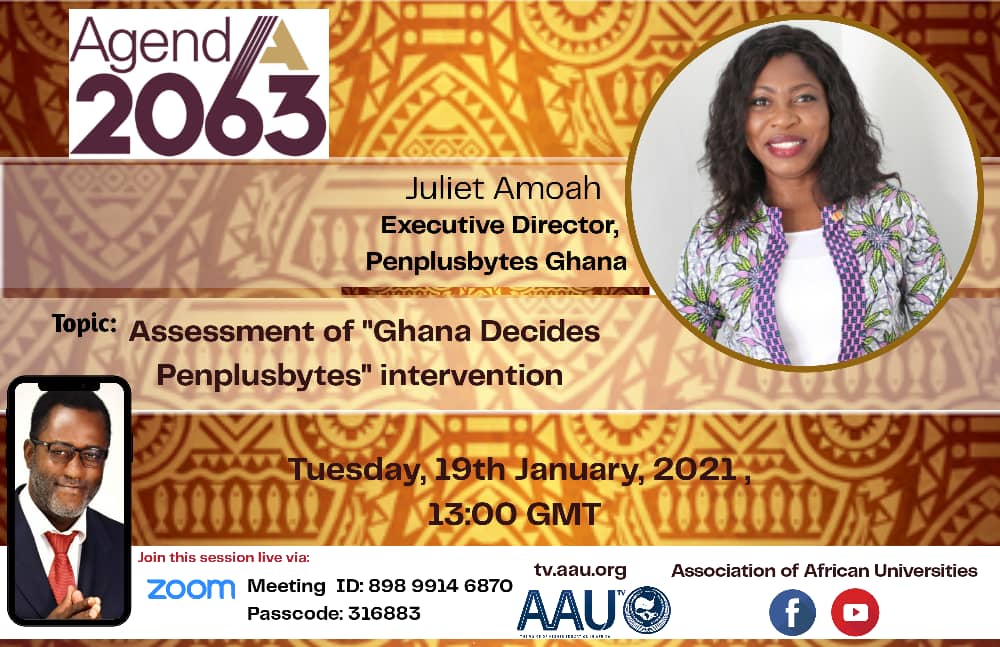
Agenda 2063 is inviting you to a scheduled Zoom meeting with Juliet Amoah, on the topic " *Assessing the Ghana Decides Penplusbytes" Intervention*.


Topic: AAU TV's Zoom Meeting

Time: Jan 19, 2021 01:00 PM Reykjavik


Join Zoom Meeting

https://us02web.zoom.us/j/89899146870?pwd=bmIwRnlQenNLbys3YSt6SUpXWGdEQT09


Meeting ID: 898 9914 6870

Passcode: 316883

One tap mobile

+12532158782,,89899146870# US (Tacoma)

+13017158592,,89899146870# US (Washington D.C)


Dial by your location

        +1 253 215 8782 US (Tacoma)

        +1 301 715 8592 US (Washington D.C)

        +1 312 626 6799 US (Chicago)

        +1 346 248 7799 US (Houston)

        +1 646 558 8656 US (New York)

        +1 669 900 9128 US (San Jose)

Meeting ID: 898 9914 6870

Find your local number: https://us02web.zoom.us/u/kbWowKI6aF


--
*****************************************************
E.K.Bensah Jr, 
*Deputy Executive Director -- AfCFTA Policy Network-Ghana & Diaspora
*AU Department of Trade & Industry Media Network on Africa's Industrialization
*Agenda2063 Media Network Member
*APRM Communicators Network
*M-D, EcowasBusinessNews.blogspot.com
*Head of Comms & Research & Host -- "Africa in Focus Show" /AIFTV
*former Exec Producer -- XYZ Africa News Bulletin@8

#####
http://www.twitter.com/ekbensah | 
*TEL:+233.268.687.653 / +233.233.311.789 / +233.243.111.789
*eml: ekbensah@gmail.com | africainfocusshow@gmail.com
*Telegram/Whatsapp:+233.233.311.789
AFRICA IN FOCUS: africainfocusshow.blogspot.com
________________________________________________________________________________
EKBENSAH DotNet: Regional integration Intelligence| West Africa-ECOWAS | Communications | Civil society 
_________________________________________________________


*PRESS RELEASE*: High-Level Dialogue at Africa Climate Summit Explores "Africa’s Green Minerals Strategy" as a Catalyst for Continental Minerals-based Industrialization.

FOR IMMEDIATE RELEASE High-Level Dialogue at Africa Climate Summit Explores "Africa's Green Minerals Strategy" as a Catalyst f...